

Knowing which thoughts are mine
Once an AI writes a significant portion of your content, you need labels.

This is part 5 of my Robodex series, where I explain how I was finally able to solve my Second Brain frustrations.
Part 1 - How I finally solved my Second Brain frustrations
Part 2 - Growing my second brain one mistake at a time
Part 3 - Leveraging Skills: turning “do that thing again” into a trigger phrase
This chapter is some what of a weird duck in the bite, or as the British would say: an odd one out. But when your knowledge base is built around AI generated content, this is very important to implement.
About 6 months into using an AI to maintain my second brain, I sat down to read a note I’d saved about AI governance frameworks. But when I got three paragraphs in, I couldn’t tell whether I had actually formed the opinion it expressed or whether the model had summarised a source into something that read like my opinion. The note’s frontmatter said authored_by: ai-assisted. I had apparently reviewed and accepted it at the time, but I just couldn’t tell, anymore, whether what was mine and what wasn’t.
That is the provenance problem, and it gets structurally worse over time. The vault accumulates and gets bigger. Notes link to other notes. An analysis synthesising four sources draws on summaries, and the summaries were written by a model in sessions I don’t fully remember. By the time you’re writing a client briefing or a public article and citing the vault as source material, the epistemic status of what you’re citing is opaque — unless you labelled it at the moment of creation.
Every note in the Robodex carries three fields in its frontmatter, applied at the moment the note is written:
authored_by: ai-assisted
ai_model: claude-sonnet-4-6
ai_influence: ai-collab
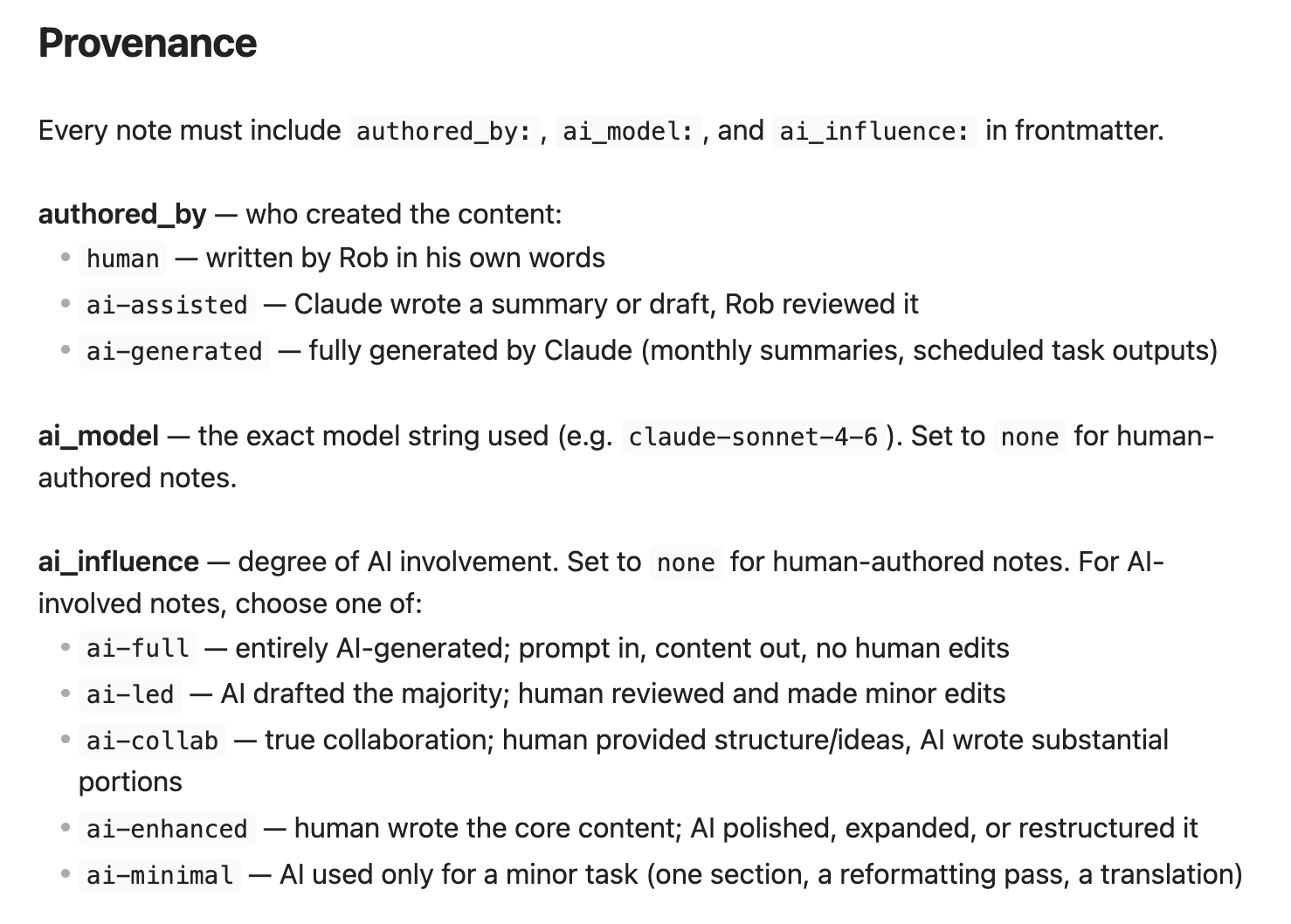
authored_by records who created the content: human (written by me in my own words), ai-assisted (the model drafted or summarised, I reviewed it), or ai-generated (fully generated by the model without human editing, used for scheduled task outputs like monthly summaries). ai_model is the exact model string: claude-sonnet-4-6, claude-opus-4-8. ai_influence is the degree of involvement across five levels: ai-full (prompt in, content out, no human edit), ai-led (the model drafted the majority, I made minor edits), ai-collab (genuine joint authorship), ai-enhanced (I wrote the core, the model polished or restructured), ai-minimal (the model handled only a small mechanical task, like a reformatting pass).
The Claude.md file has clear guidance on which labels should be used:
The cost of applying these is a few seconds per note, but the actual value stays throughout the usage of the database.
The model string matters more than it initially seems, for a reason that becomes clearer as the AI landscape shifts.
A summary written in early 2026 by a specific model carries different reliability characteristics than one written by a different model in late 2026: different reasoning patterns and different failure modes in specific domains. If I’m reading a note in 2028 and deciding how much weight to give an inference it makes, knowing which model wrote it is useful context. The model string anchors the note to a moment in AI development. That anchor has value when the landscape shifts around it, as it reliably does.
The exact model string also does something subtler: it forces honesty about whether AI was involved at all. Vague labels like “AI-assisted” are easy to apply loosely, meaning “AI helped somehow,” which covers everything from “the model wrote the whole thing” to “I used autocomplete.” An exact model string requires actually recalling whether a model was used in that session, because there is no way to fake the version number without knowing which model was open at the time.
The distinction between ai-full notes and human notes changes how I use the vault as a thinking tool. An ai-full note is a lead: something the model generated from a prompt that I haven’t independently verified or thought through. It might be accurate and well-reasoned. I haven’t claimed it. A human note is a position I hold, something I wrote, something I can stand behind in a conversation or a document.
The vault currently has 32 notes marked ai-full:

Most are monthly summaries and scheduled task outputs: things the agent generates autonomously as part of its night-shift work. Of the 547 total notes, the majority carry some level of human involvement.
Organisations face the same problem at a scale where the consequences are larger. AI produces reports, analyses, briefings. The provenance disappears. Six months later, no one can reconstruct which decisions were made based on AI-generated summaries versus verified human analysis, or which model version was used in a period when that model later turned out to have systematic blind spots in a particular domain. The downstream consequences of this opacity are already visible in regulated industries where the provenance of advice and analysis is itself a compliance question.
I solved the problem for one person, in one vault, with three frontmatter fields applied at creation time. The implementation is not a blueprint for a corporate knowledge system. The principle is: label AI involvement at the moment of creation, with enough specificity that future readers can assess what they’re reading. Provenance cannot be reconstructed after the fact. The moment to label is when the note is written.