

Growing my second brain one mistake at a time
How to use the main instructions as your rules and requirements.

Ofcourse I had to give my second brain a cool name. And inspiration can come from unexpected places. My son recently start watching Pokémon (yes, the OG from 1997) and it suddenly hit me that there was no other way then to name it my Robodex. Hence the title of this series.
This is part 2 of my Robodex series, where I explain how I was finally able to solve my Second Brain frustrations.
Part 1 - How I finally solved my Second Brain frustrations
The fundamental constraint of any current AI assistant is that it holds no memory between sessions. Open a new conversation and the agent starts from zero: no recall of the notes it filed last week, no knowledge of the folder structure it has worked with for six months, no awareness of the mistake it made three sessions ago. The only thing that carries information forward is what you wrote down. CLAUDE.md is what I wrote down.
It is a markdown file at the vault root, currently running to about 1,500 words. The agent reads it at the start of every session. Think of it as an onboarding document for a worker who resets completely each Monday morning: the vault structure, the routing rules, the filename conventions, what operations require confirmation, what never to attempt. Write it poorly and the agent improvises. Write it precisely and the agent is predictable. The difference between those two outcomes, across six months of daily use, is substantial.
Structure is the key
Any data store should start with structure, but because it’s hard to think about where it will grow, it’s important to start small. When I started, I only had 3 top folders: Notes, Templates & Analysis. Now it has grown to the structure explained in the previous post.
Remember that the basis is just markdown files in folders, so re-arranging the structure is as simple as writing a prompt.
The vault structure block at the top of the Claude.md file looks like this (it only shows the inbox & sources in this image):
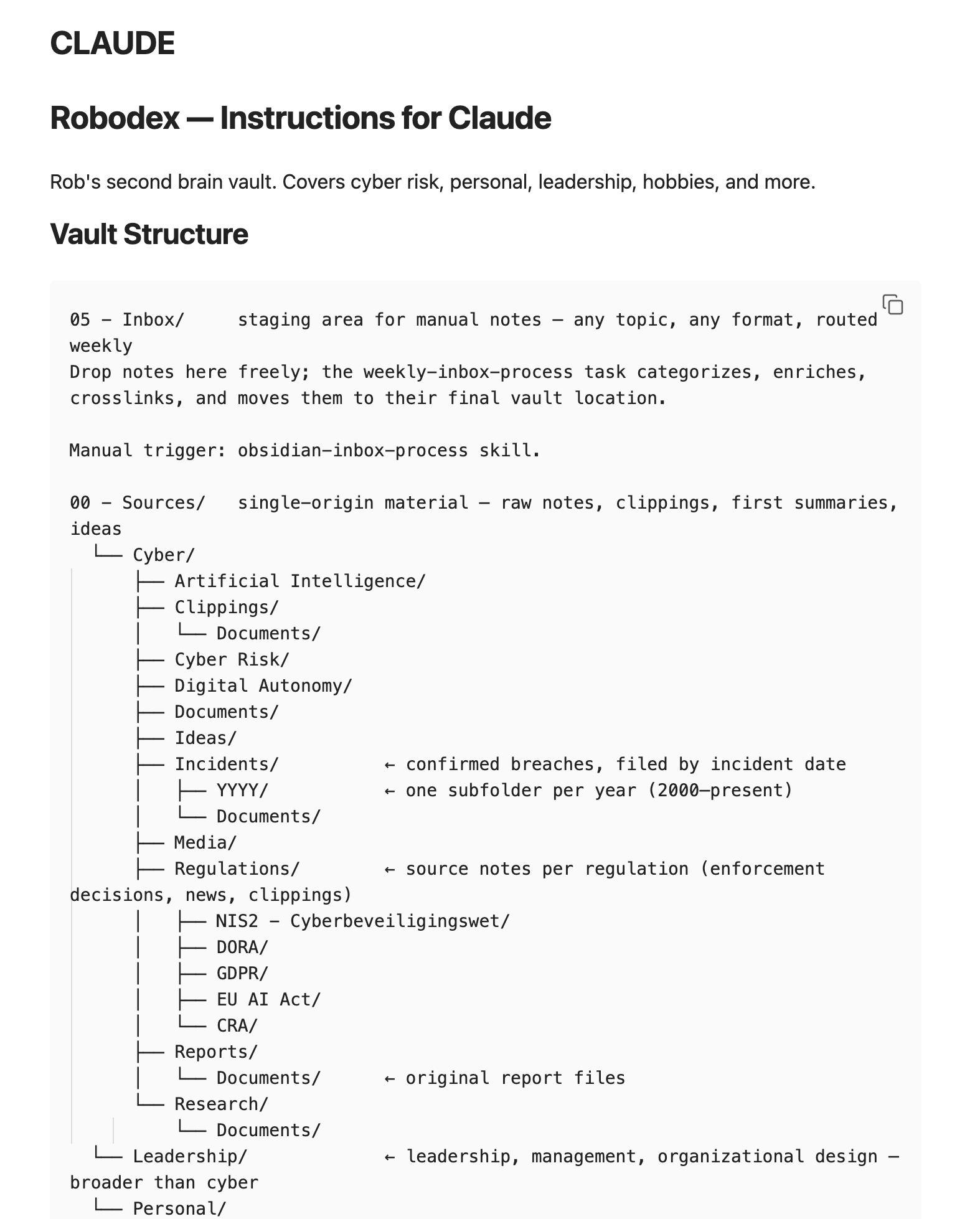
The file is called Claude.md because that’s the instructions file Cowork will reference for its global instructions. For other tools or agents this might differ. I’ve let Claude create a ‘Setup’ folder within my second brain, which includes the instructions, skills, schedules, etc. written in such a way that it doesn’t reference any Claude specific parameters, so that (in theory) I will be able to transfer it to another tool. I’ve recently tested this by rebuilding the setup in Mistral Vibe and with some fine-tuning, this does seem to work pretty well.
The inline comments are not decorative. An agent told “05 - Inbox is for rough notes” will make different decisions than one told “staging area; the daily task categorizes, enriches, crosslinks, and moves them to their final vault location.” The second version is a job description. It tells the agent not just what the folder is, but what process it belongs to and what should happen to everything that lands in it. That specificity is the difference between an agent that files correctly and one that improvises.
The most load-bearing section of the file is the layer-routing decision table. Every note the agent processes has to be placed somewhere in the vault’s eight layers, and the rules that govern that placement are exactly the kind of decision that collapses into inconsistency when expressed in prose. A table with explicit decision rules has proven more reliable than any amount of paragraph-form guidance:
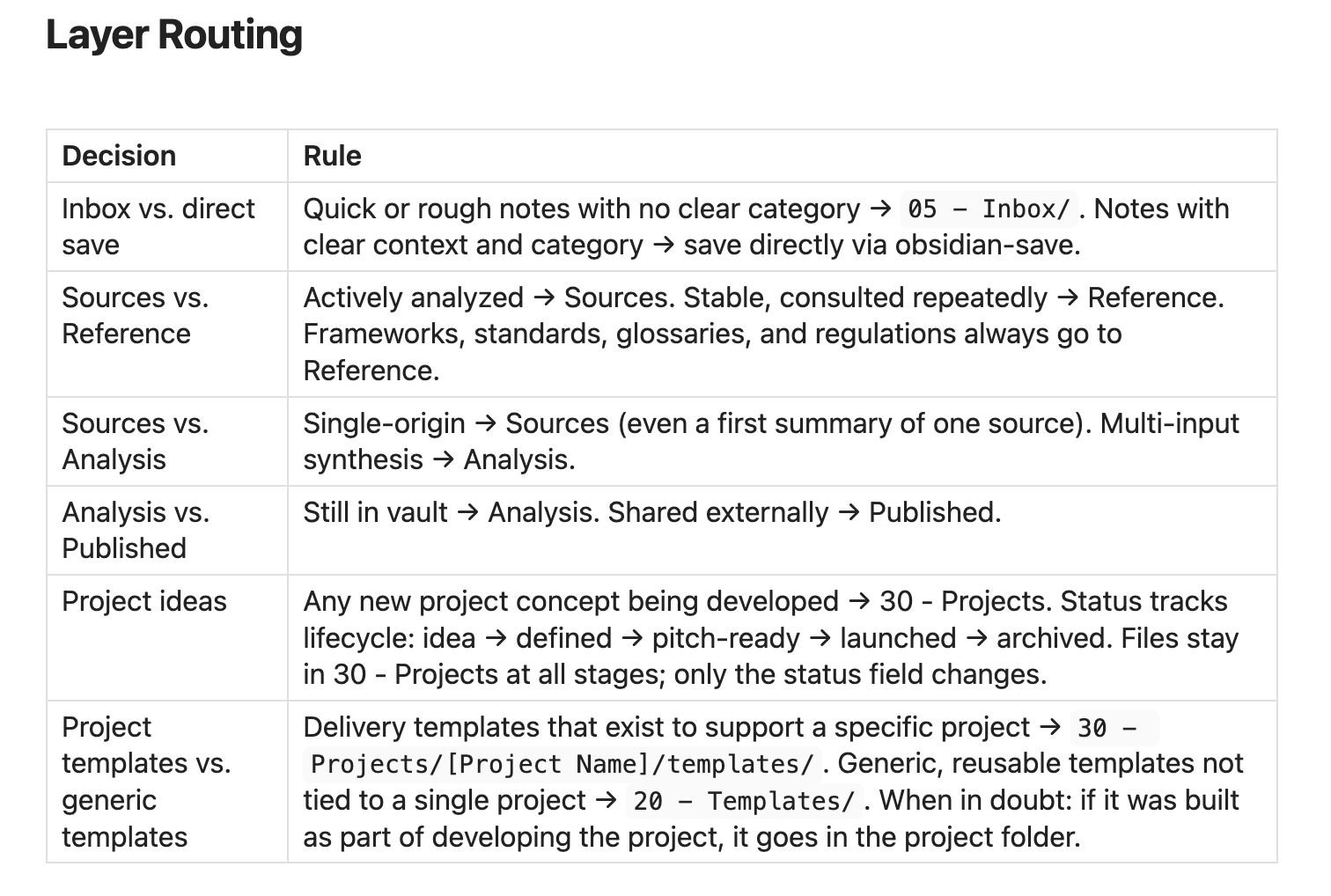
Six rows. The agent has never misrouted something this table covers.
Continuous Improvement
CLAUDE.md started at about 200 words. It grew to its current length through a process that is less a design exercise than a feedback loop: every time the agent does something wrong, I write a rule. A verbal correction in conversation is forgotten by the next session; a rule in the file persists. Mistakes compound into precision.
The incident-specific frontmatter section is a useful illustration. The vault tracks confirmed cyber incidents, and early notes had inconsistent geography fields: “Netherlands” in one, “The Netherlands” in another, “NL” in a third. The fix was two rows of enumerated values:
geography: NL | EU | Global
sector: [Government, Finance, Healthcare, Telecom, Energy, Retail, Manufacturing, Technology, Education, Aviation, Defence, Sports, AI]
Exact values that are clearly listed. The agent picks from the list. The result was that inconsistency across 100-odd incident notes was completely gone.
Tag formatting had the same problem, Obsidian doesn’t support multi-word tags with spaces, and the agent kept producing supply chain instead of supply-chain. One sentence in the file fixed it permanently: “Tags must be a single word or hyphenated.” The rule has been followed in every session since.
The clearest example of what CLAUDE.md is actually for involves the Personal folder.
The vault includes a section for personal notes: invoices, holiday planning, recipes, an overview of the LEGO I own. Early on the agent occasionally crosslinked cyber research notes to personal content when a keyword matched tangentially. A NIS2 enforcement note would acquire a crosslink to a grocery receipt because both mentioned “the Netherlands.” I added a routing boundary to the file: Personal/ is a separate subtree; crosslinks do not cross the boundary between it and the cyber content.
Every mistake the agent makes is now a candidate for a new rule. The manual compounds over time, and the agent working with the vault today is better-instructed than the one from six months ago, not because the model changed but because the instructions and rules got more precise.
Growing one mistake at a time
The file has limits worth naming. The agent occasionally ignores a rule, and the pattern is consistent: it happens most often when a rule is written in prose rather than as a table or an enumerated list. The response is always the same, which is to tighten the rule. I’ve never had to correct the same mistake three times. The second correction always involves converting prose to a table or replacing vague guidance with explicit values.
There is also a category CLAUDE.md can’t cover: genuinely novel situations the file never anticipated. When those arise, the agent improvises. Sometimes the improvisation is fine. Occasionally it produces a mess. For file operations, which are the irreversible category, I added hard limits: never delete files, confirm before anything goes to the removal queue. Content decisions have latitude, but file operations have hard limits.
Any AI you work with repeatedly needs a written operating manual, and every mistake it makes should become a rule in it. This applies past knowledge management to coding agents, drafting agents, support agents: any AI doing the same type of work more than a few times will drift without a contract.
Key Takeaway
Don’t copy my setup & start small. Ask your AI Agent to help you build a second brain and ask it to be critical and assess your specific usecase. Let it create a generic instruction file that starts small. 200 words and one routing table is enough to begin. The manual earns its length over time, and the earning is done one mistake at a time.